
Hogwarts Legacy puts you in the robes of a student wizard navigating Hogwarts School of Witchcraft and Wizardry, and the controls are your gateway to mastering spells, exploring the castle, and surviving intense duels. Whether you’re playing on PS5, Xbox Series X/S, PC, or Nintendo Switch, understanding your Hogwarts Legacy controls is the difference between fluid, immersive gameplay and frustrating command delays. The game’s control schemes are deeply customizable, and finding the right setup for your playstyle, whether you prioritize fast combat or precise positioning, can dramatically improve your experience. This guide breaks down every control option, from basic movement to advanced combat techniques, so you can fine-tune your setup and jump into the wizarding world with confidence.
Table of Contents
ToggleKey Takeaways
- Hogwarts Legacy controls are fully customizable across PS5, Xbox Series X/S, PC, and Nintendo Switch, allowing you to remap buttons for faster combat or better accessibility.
- Master the perfect dodge mechanic by timing your roll just before an enemy attack to trigger slow-motion, a critical skill that separates casual players from advanced ones.
- A balanced spell loadout of Stupefy (stun), Incendio (damage), a utility spell, and Protego (shield) creates a flexible foundation for most combat encounters, including boss fights.
- Finding your ideal camera and movement sensitivity takes practice—start with defaults, adjust by 2-3 units at a time, and spend at least 2-3 hours playing before changing settings again.
- Competitive Hogwarts Legacy players bind spells to number keys (PC) or remap triggers (console) to cast without opening the spell wheel, significantly speeding up reaction time during intense battles.
- If experiencing input lag or controller issues, check controller battery levels, disable V-Sync, close background programs, and update drivers before assuming a hardware failure.
Getting Started With Controller Setup
Default Control Schemes on Console
On PS5 and Xbox Series X/S, Hogwarts Legacy ships with a pre-configured layout that maps core actions to familiar button locations. The X button (PS5) or A button (Xbox) handles basic interactions, while R1/RB casts your equipped spell and L1/LB activates your shield charm. Movement uses the left stick, camera control uses the right stick, and Triangle/Y pulls up your spell wheel for quick selection.
Nintendo Switch follows a similar structure but with button remapping due to the Joy-Con layout. The controller sensitivity defaults to moderate values, which works fine for most players but may feel sluggish in combat for those used to faster-paced action games.
Console players should know that the game supports both standard and adaptive controllers. If you’re using PlayStation’s Access Controller or Xbox’s Adaptive Controller, Hogwarts Legacy recognizes these and allows remapping to individual buttons or switch controls.
PC Keyboard and Mouse Configuration
PC players get granular control from day one. By default, Hogwarts Legacy maps spell casting to right-click, movement to WASD, and camera control to the mouse. The E key handles interactions, Tab opens your spell wheel, and Shift lets you sprint. Mouse sensitivity is measured in units (default is around 15-20), and you can adjust it in-game without third-party tools.
Keyboard players often prefer remapping frequently-used spells to number keys (1-4) for faster access during combat. Some competitive players bind dodge to spacebar and camera rotation to Q/E for more ergonomic positioning. Unlike console players, PC users can use external macro software, though Avalanche Software doesn’t officially endorse it, stick to in-game remapping for stability.
Mouse acceleration is disabled by default, which is ideal for consistent aim. If you’re coming from other action RPGs, you’ll find the mouse responsiveness snappy but not twitchy.
Customizing Your Control Layout
Both console and PC allow full button remapping through Settings > Controls > Remap Controls. You can rebind almost every action: spellcasting, shield charm, dodge, interact, and more. The game won’t let you bind two actions to the same button (except when using alternate action sets), so you’ll need to carefully plan your layout.
Console players often rebind L2/LT to a secondary spell cast, letting them cycle spells without dropping the spell wheel. PC players sometimes swap Shift and Spacebar for sprint and dodge, matching muscle memory from games like Dark Souls or Elden Ring.
Pro tip: Don’t just customize for comfort, think about gameplay flow. A well-organized control scheme keeps your hands relaxed and your reaction time sharp during extended play sessions. Test your layout for at least an hour before committing: it takes time to rewire muscle memory.
Combat Controls and Spell Casting
Basic Attack and Defense Mechanics
Your primary attack in Hogwarts Legacy comes from your equipped wand attacks, triggered by R1/RB (console) or right-click (PC). These basic swings are quick, deal moderate damage, and chain together in three-hit combos if you keep the button pressed. Defense relies on L1/LB (console) or right-click + hold (PC) to cast Protego, your shield charm that blocks incoming damage and can be held indefinitely.
Dodging is equally critical: press X/A (console) or spacebar (PC) to roll away from enemy attacks. Timing your dodge just before an enemy strike triggers a perfect dodge, which briefly slows time and lets you reposition without penalty. This mechanic is crucial against bosses, and mastering it separates good players from great ones.
The stamina system doesn’t exist as a hard limit, but spamming attacks without breaks will leave you vulnerable. A rhythm of attack-dodge-attack-shield works well for sustained encounters.
Assigning and Casting Spells
You can equip four spells at a time, mapped to your spell wheel. On console, hold Triangle/Y to open the wheel, then use the right stick to select and release to cast. On PC, hold Tab, move your mouse to the spell, and click to cast. Your equipped spells are also hot-bindable: some players manually assign them to L2/LT, R2/RT, and other shoulder buttons via remapping for one-button casting during intense fights.
Spell variety matters hugely. Offensive spells like Stupefy (stun) and Incendio (fire damage) handle direct damage, while utility spells like Wingardium Leviosa (levitation) and Diffindo (cutting curse) apply crowd control or environmental effects. Defensive spells like Protego and Baruffio’s Brain Elixir (damage buff) round out your arsenal.
Research from Game8 shows that meta spell loadouts shift with each major patch. Currently, Stupefy + Incendio + Diffindo + Protego is a solid jack-of-all-trades setup, but you’ll want to experiment based on enemy types and your playstyle.
Quick Cast vs. Held Cast Options
Hogwarts Legacy defaults to instant casting: press the button, spell fires immediately. But, you can toggle Held Cast in settings, which requires you to hold the spell button and aim a targeting reticle before releasing to cast. Held Cast is slower but offers superior accuracy, especially for spells like Diffindo that benefit from precise positioning.
Most competitive players stick with Quick Cast for speed, reserving Held Cast for specific utility spells where aiming matters. If you’re struggling with spell accuracy, switching to Held Cast for a few combat encounters can build your spatial awareness before switching back to Quick Cast.
Movement and Camera Controls
Walking, Running, and Sprinting
Movement in Hogwarts Legacy uses the left stick (console) or WASD (PC). Pushing the stick forward walks: pressing Shift (PC) or double-tapping the stick (console) enters sprint mode, which drains stamina over time but lets you cover distance fast. Sprint is essential for exploration and escaping enemy groups, but overusing it during combat leaves you defenseless.
Walking while aiming with L2/LT (console, held cast mode) slows your movement to allow precise targeting. This is useful when lining up environmental spells or navigating tight corridors.
Console players should adjust controller sensitivity for movement independently from camera sensitivity. A higher movement speed feels responsive without making aiming twitchy.
Camera Sensitivity and Adjustment Settings
Camera sensitivity is measured in units and defaults to 15 on console, 20 on PC. Console players in combat typically prefer higher sensitivity (18-25) for quick target switching, while exploration players benefit from lower settings (10-15) for smoother panning. PC players should match their sensitivity to other games they play: if you’re used to valorant sensitivity, Hogwarts Legacy’s default will feel sluggish.
Horizontal and vertical sensitivity can be adjusted independently. Some players like matched values, while others prefer slightly lower vertical sensitivity to prevent overshooting when aiming up or down. Test both: there’s no universal “best” setting.
Acceleration curves are not adjustable in-game, but the game uses linear scaling by default, which feels responsive without feeling out of control. Mouse DPI settings on your peripherals affect sensitivity: if the game feels unresponsive, check your mouse DPI before changing in-game settings.
Navigating Tight Spaces and Puzzles
Castle exploration often involves narrow corridors and environmental puzzles that require precise positioning. Use walking (not sprinting) when navigating tight spaces to avoid overshooting doorways or falling off ledges. The camera can sometimes clip through walls in confined areas, this is a known quirk, not a control issue.
For puzzle segments that require moving objects or casting spells on specific targets, held cast mode (mentioned earlier) becomes invaluable. Switching to Held Cast temporarily, solving the puzzle, then switching back to Quick Cast keeps you efficient without sacrificing combat performance. Many players bind a “toggle cast mode” button for this exact reason.
Interaction and Exploration Controls
Interacting With NPCs and Objects
Interacting with NPCs, reading books, and activating environmental objects uses E (PC) or X/A (console). When you approach an interactive element, a prompt appears on-screen showing the button. Most interactions are instantaneous, approach a character, press the button, and dialogue begins.
Some objects have delayed or held interactions. For example, collecting plants for potion ingredients requires holding the interact button for a short duration. This is intuitive and rarely causes issues, but be aware that moving away cancels the interaction.
Console players should note that interaction range is forgiving. You don’t need pixel-perfect positioning: standing within a few feet of an NPC or object makes the prompt appear.
Opening Doors, Chests, and Locked Areas
Doors and chests use the same interact button. Regular doors open instantly when you press interact. Locked doors require specific spells or items, the prompt tells you what’s needed. For example, a door with a Barricade Curse requires Alohomora spell to open, while a magically sealed door might need a key from elsewhere.
Chests contain loot and use the same X/A or E button to open. Interior chests open instantly: ornate chests sometimes have locks requiring Alohomora. The game telegraphs locked chests clearly, so you’ll never get stuck wondering why a chest won’t open.
Fastly traveling between known locations uses the fast travel menu, accessed from the map (see next subsection). Fast travel saves time during exploration but isn’t available during combat or in areas with active enemies nearby.
Fast Travel and Menu Navigation
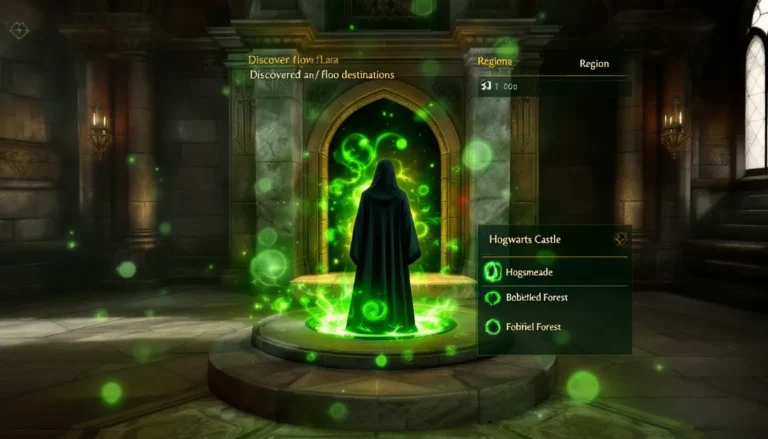
Press Esc (PC) or Menu/Options button (console) to open the main menu. From there, select Map to see the Hogwarts world. Previously-visited Floo Powder locations appear as fast travel points. Select one and confirm to teleport instantly.
The Pause menu on console uses the traditional back/select button (depends on which PlayStation/Xbox generation). Menu navigation uses the directional pad or right stick to highlight options, then X/A to confirm. It’s standard stuff, but menu responsiveness matters when you’re juggling spells and potions mid-fight.
PC players can also access the map with M and fast travel with a mouse click. Keyboard navigation is snappier than controller menu navigation, which is why competitive players often prefer PC for fast item management. Inventory management controls are straightforward: select an item and press X/A (console) or E (PC) to use or equip it.
Advanced Combat Techniques
Stunning Spells and Special Moves
Stupefy is your crowd-control linchpin: it stuns enemies for a brief window, letting you escape or chain follow-up spells. Combining Stupefy with Incendio (fire damage) creates burst damage: a stunned enemy can’t dodge the incoming fire spell, guaranteeing a hit.
The Curse spells (Crucio, Imperio, Avada Kedavra) are powerful but slow. These dark spells require setup: often you’ll stun with Stupefy first, then follow with a Curse for maximum damage. Avada Kedavra is the hardest-hitting spell in the game but has the longest cast time, making it risky in group fights.
Special moves and finishing moves trigger when enemies reach low health. The game prompts you with a button press (usually Square/X) to execute a cinematic finisher. These are guaranteed hits and deal massive damage, so always confirm the prompt when it appears.
Parrying and Dodging Attacks
Parrying isn’t a dedicated mechanic: instead, Protego (shield charm) absorbs incoming damage and can reflect projectile spells back at enemies. Holding Protego is safer than dodging because it doesn’t leave you vulnerable if you time it wrong. But, Protego drains your spell slots, so it’s not a permanent solution.
Dodging (roll) remains your best defensive tool. The perfect dodge mechanic, timing your roll just as an attack lands, briefly slows time and resets your positioning. This is a skill-based move that separates casual and hardcore players. Practice dodging in early combat encounters against weaker enemies to build muscle memory.
Boss encounters reward aggressive, well-timed dodging. Many boss attacks have clear wind-ups: learn these patterns and dodge accordingly. Overrelying on shield charm will drain your spell power: dodge instead whenever possible.
Boss Encounter Control Tips
Boss fights demand precision. Before engaging, equip a balanced spell loadout: one stun spell (Stupefy), one damage spell (Incendio or Diffindo), one utility spell (Wingardium Leviosa for crowd control), and one defensive spell (Protego). This flexibility handles most boss mechanics.
Pay attention to boss attack patterns. Most bosses telegraph their moves with voice lines, animations, or particle effects. Watch for these tells and respond accordingly: dodge heavy attacks, shield projectiles, and stun when the boss becomes vulnerable.
Keep moving. Standing still makes you an easy target for ranged attacks. Strafe around the boss using the left stick, constantly repositioning. This simple habit dramatically reduces incoming damage.
Research from Twinfinite’s boss guides suggests that patience beats aggression. Don’t spam spells: instead, land 2-3 spells, dodge/shield, and repeat. Running out of spell power mid-fight is the fastest way to lose.
Accessibility and Custom Controls
Remapping Buttons for Accessibility
Hogwarts Legacy’s remapping system is robust enough to accommodate players with limited mobility. You can bind any action to any available button, and some players use external devices like one-handed controllers or accessibility switches alongside in-game remapping.
For players with limited hand strength, rebinding frequently-used actions (spell cast, shield, dodge) to easier-to-press buttons reduces fatigue. Some players move dodge from X/A to Shift (PC) or L1/LB (console) to avoid repeated button mashing.
Console adaptive controllers (PlayStation Access Controller, Xbox Adaptive Controller) work seamlessly with Hogwarts Legacy. The game’s remapping respects these custom layouts, letting accessibility users configure the game for their specific needs.
Colorblind Modes and Visual Feedback
Hogwarts Legacy includes colorblind modes for Deuteranopia, Protanopia, and Tritanopia. These modes adjust the UI and spell effects to ensure enemy health bars, spell indicators, and environmental cues remain visible.
Visual feedback is crucial during combat. Enemies flash red when stunned, spells light up with bright colors, and successful hits trigger screen effects. These visual cues work even with colorblind modes enabled, ensuring accessibility doesn’t compromise clarity.
Text size is adjustable in the accessibility menu. Increasing text size helps players with vision impairments read dialogue and menus without strain.
Motion Controls and Haptic Feedback Options
PS5 controllers feature haptic feedback and adaptive triggers, which Hogwarts Legacy uses to convey combat feedback. Casting a spell triggers vibration: blocking with Protego creates resistance on the trigger buttons. These subtle touches enhance immersion and can actually help with timing since you feel feedback in real-time.
Motion controls are not heavily featured in Hogwarts Legacy, it’s not a motion-centric game. But, some players toggle motion aiming for precise spell targeting, similar to Breath of the Wild. Motion aiming is optional and can be disabled entirely in accessibility settings.
PC and Xbox players don’t have motion controls, but Xbox Series X/S controllers do support haptic feedback similar to PS5. Games utilizing this feature feel more responsive.
Pro Tips for Optimizing Your Controls
Finding Your Ideal Sensitivity Settings
Sensitivity isn’t one-size-fits-all. Start with the default and spend 15-20 minutes in low-stakes combat, fighting weak enemies or practicing in a safe area. If you’re overshooting targets or turning too slowly, adjust by 2-3 units and test again.
Console players should test sensitivity in both exploration and combat. Exploration prefers lower sensitivity for smooth panning, while combat prefers higher sensitivity for quick target switches. If you can’t decide, go with a middle value (16-18) and accept minor compromises.
PC players coming from other games should match Hogwarts Legacy sensitivity to your primary shooter. If you play Valorant with 800 DPI and 0.5 sensitivity, you’ll want Hogwarts Legacy around the 12-15 range. IGN’s sensitivity guides cover this across multiple games if you need a reference.
Trust the process: it takes 2-3 hours of play before new sensitivity feels natural. Don’t keep adjusting constantly: pick a value and stick with it for at least a full gaming session.
Button Remapping for Faster Combat
Competitive players optimize button placement for speed. The most efficient layouts minimize hand movement and keep your fingers on essential buttons. Here’s a competitive loadout example:
- R1/RB: Spell cast (default)
- L1/LB: Protego shield (default)
- X/A: Dodge (default)
- L2/LT: Secondary spell cast or potion use (remapped)
- R2/RT: Spell wheel (remapped)
This layout keeps both thumbs active simultaneously: right thumb handles combat on face buttons, left thumb handles movement and secondary actions on triggers.
PC players can use keybinds creatively. Binding spells to 1, 2, 3, 4 lets you cast without opening the spell wheel. Binding dodge to spacebar instead of requiring mouse movement speeds up reaction time significantly.
The key is reducing context switches. If you’re constantly opening menus or wheels, you’re slower than someone who’s already equipped what they need.
Practice Routines to Master Control Schemes
New control schemes require deliberate practice. Spend your first gaming session focused on adaptation, not progression. Load into a combat encounter and practice dodging, shielding, and casting spells for 30 minutes straight.
The Hogwarts Legacy practice arenas (early game areas with weak enemies) are perfect for this. Fight the same enemy type repeatedly to build muscle memory. After 2-3 hours, your new controls will feel intuitive.
Another practice tip: record yourself playing and watch for inefficiencies. Are you constantly fumbling for your spell wheel? That’s a rebinding opportunity. Are your dodges late or early? That’s a timing issue fixable through practice.
Final thought: don’t overthink optimization. A comfortable setup you’ve practiced with beats the “theoretically optimal” layout you haven’t internalized. Play what feels good, adjust incrementally, and trust repetition.
Troubleshooting Common Control Issues
Controller Not Responding or Disconnecting
Console controllers occasionally disconnect mid-session. First, check your controller battery (especially for wireless controllers). A low battery causes input lag or complete disconnection. Charge the controller fully and test again.
If disconnection persists, re-pair the controller with your console. This forces your console to recognize the controller’s latest firmware and settings. For PS5, go to Settings > Accessories > Controllers > Pairing, then hold the pairing button on your controller. Xbox users should go to Settings > Devices & Connections > Accessories and sync the controller.
Software bugs occasionally cause inputs to be ignored. Try restarting Hogwarts Legacy entirely. If that doesn’t work, update your console’s operating system and any pending game patches. Avalanche Software regularly releases control refinements in patches.
Controller drift, where the analog stick registers movement even at rest, affects older controllers. This is a hardware issue, not a software one. Rebuilding your controller’s stick calibration helps temporarily, but drift eventually requires a new controller.
Keyboard Input Lag or Delays
PC players occasionally experience input lag where key presses register late. First, disable V-Sync in graphics settings if you’re experiencing frame rate stutters. Input lag often accompanies frame drops.
Second, check if background programs are consuming CPU resources. Overlay software (Discord, OBS, streaming apps) can introduce latency. Close unnecessary background apps, then relaunch Hogwarts Legacy.
Third, update your keyboard drivers. Old drivers sometimes cause input delays. Visit your keyboard manufacturer’s website and download the latest driver version.
If lag persists after these steps, your hardware might be the culprit. High ping (playing on a far-away server, if applicable), USB hub overload, or old peripherals can introduce latency. Test with a different keyboard if possible.
Resetting to Default Controls
If you’ve remapped extensively and want to start fresh, go to Settings > Controls > Remap Controls, then select Restore Defaults. The game confirms before wiping your custom layout.
Alternatively, you can reset individual actions without wiping everything. Scroll to the action you want to reset, press Reset This Action (console) or right-click > Reset (PC), and it reverts to default.
Note: resetting controls doesn’t affect sensitivity or accessibility settings. Those remain unchanged unless you manually adjust them. This lets you reset button layouts while preserving personalized sensitivity and visual settings.
Conclusion
Mastering Hogwarts Legacy controls comes down to understanding your options, customizing for your playstyle, and practicing until your setup feels second nature. Whether you’re exploring Hogwarts on console or competing in combat on PC, the game’s flexible control system accommodates everyone from casual players to optimization enthusiasts.
Start with the defaults, adjust sensitivity to match your preferences, and don’t be afraid to remap buttons for efficiency. Boss fights and intense exploration segments reward precise control and quick reflexes, both of which improve dramatically with a setup tailored to you.
Your controls are the bridge between your intentions and the game. Spend time fine-tuning, practice deliberate repetition, and you’ll unlock the full potential of Hogwarts Legacy’s combat and exploration systems. The wizarding world awaits, and now you’ve got the controls to handle it.
placeholder
placeholder